
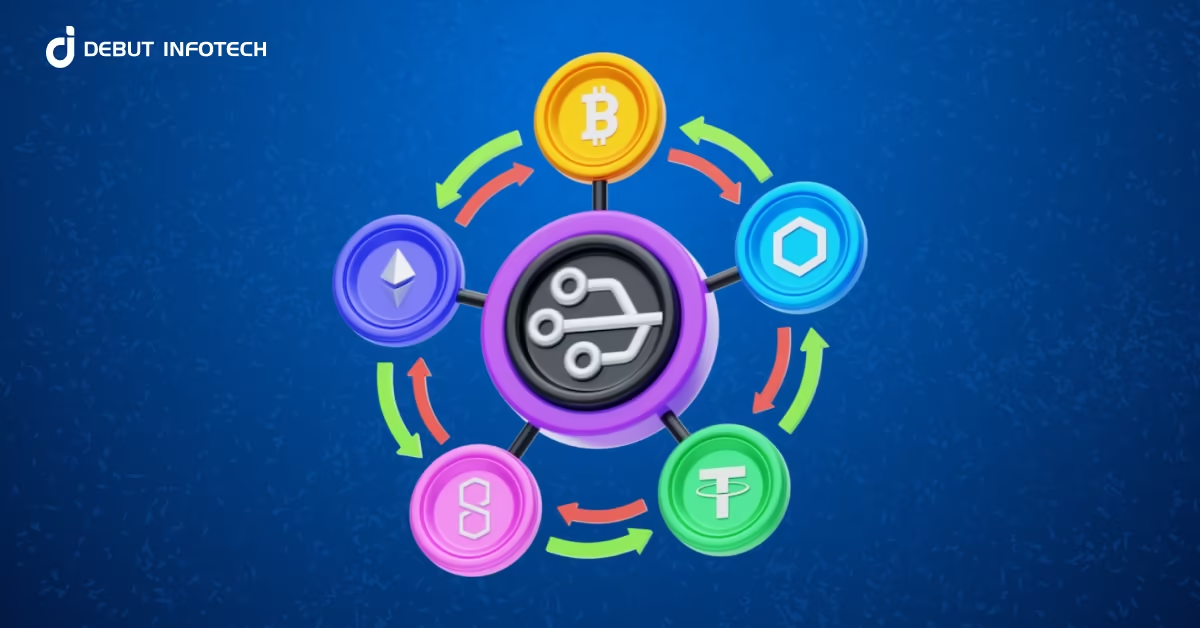
Crypto trading has long been split into two worlds: centralized exchanges (CEXs) and decentralized exchanges (DEXs). Each has its strengths and weaknesses. CEXs offer deep liquidity, rapid execution, and fiat on-ramps—but custody risk and regulatory friction remain. DEXs provide trustless trading, composability, and innovation—but often suffer from lower liquidity, higher slippage, and limited advanced trading tools.
Now, a new breed of platform is emerging: hybrid exchanges. They combine the best of both worlds, offering users the speed, liquidity, and convenience of centralized trading while retaining the transparency, security, and self-custody features of decentralized networks.
The rise of hybrid exchanges may signal a fundamental shift in crypto trading. But what are they exactly, and why are they poised to reshape the landscape?
What Is a Hybrid Exchange?
Hybrid exchanges integrate features of both centralized and decentralized trading. They typically combine:
- Off-chain order books for speed and efficiency, reducing transaction costs and execution lag.
- On-chain settlement, ensuring transparency and security by recording trades on the blockchain.
- Custody flexibility, allowing users to choose between self-custody wallets and platform-managed accounts.
- Cross-chain interoperability, enabling seamless asset transfers and multi-chain liquidity access.
By blending these features, hybrid exchanges aim to solve the two biggest pain points of crypto trading: trust and performance.
Why Traders Are Embracing Hybrid Models
- Liquidity Without Compromise
Liquidity has always been the strength of CEXs. Traders can execute large orders without significant slippage, access deep order books, and participate in futures markets. DEXs often lag behind in liquidity, especially for mid-cap tokens.
Hybrid exchanges merge these advantages by routing trades through aggregated liquidity pools while settling trades on-chain. The result is lower slippage, deeper pools, and faster execution—all without sacrificing transparency.
- Reduced Custody Risk
CEXs centralize user funds, making them susceptible to hacks, mismanagement, and regulatory freezes. DEXs eliminate custody risk entirely, but users face high gas fees and slower execution. Hybrid exchanges provide flexible custody solutions—allowing users to retain ownership or entrust funds to the platform as needed—striking a balance between convenience and security. - Faster Cross-Chain Trading
Multi-chain adoption is rising, and traders increasingly need to move capital across Layer-1 and Layer-2 networks quickly. Traditional DEXs can struggle with latency and bridging delays. Hybrid exchanges often integrate cross-chain routers and atomic swaps, enabling real-time arbitrage and efficient multi-chain strategies. - Regulatory Compatibility
One reason institutional players avoided DEXs was regulatory uncertainty. Hybrid exchanges can incorporate optional KYC, AML compliance, and fiat access while still offering decentralized features. This makes them attractive to both retail and institutional markets—a rare combination in crypto.
The Current Market: Examples of Hybrid Exchanges
Some emerging platforms demonstrate how hybrid exchanges are reshaping the market:
- Deversifi: Combines off-chain order books with on-chain settlement for rapid, trustless trading.
- IDEX v3: Offers high-speed trading while keeping funds in users’ wallets.
- QTrade: Integrates cross-chain swaps with a hybrid liquidity model.
- Binance DEX + CEX Integration: Although technically a CEX, Binance has begun offering hybrid-like services bridging on-chain and off-chain liquidity.
These examples highlight a growing trend: platforms no longer need to choose between speed and security—they can deliver both.
Why Hybrid Exchanges Are Gaining Momentum Now
Several macro and micro factors are fueling the rise of hybrid platforms:
- User Demand for Both Speed and Safety
Retail traders want low latency and minimal fees but also crave control over their funds. A hybrid model satisfies both needs. - Institutional Entry
As funds and trading desks move into crypto, they require regulatory compliance, deep liquidity, and transparent settlement. Hybrid exchanges provide all three. - Exploding Multi-Chain Activity
Layer-2 adoption is driving a need for rapid cross-chain execution. Hybrid exchanges act as bridges between ecosystems, enabling traders to capitalize on fragmented liquidity. - DeFi Maturity
DEX infrastructure has matured with better routing, automated market-making, and aggregated liquidity. Hybrid exchanges can now leverage these innovations without forcing users into fully decentralized wallets. - Market Volatility
Volatile markets reward speed and flexibility. Hybrid platforms allow traders to react faster than purely on-chain systems, while offering security that CEXs alone cannot provide in extreme market conditions.
Risks and Challenges for Hybrid Exchanges
Despite their promise, hybrid exchanges face hurdles:
- Complexity: Managing both off-chain and on-chain infrastructure is technically demanding. Bugs or misconfigurations can expose traders to risk.
- Regulatory Uncertainty: Balancing KYC/AML compliance with decentralized features is tricky. Missteps could attract scrutiny.
- Liquidity Fragmentation: Hybrid exchanges still compete with both DEXs and CEXs for liquidity. Network effects take time to build.
- User Education: Traders must understand when to use self-custody versus platform custody, and how settlement works. Poor onboarding could limit adoption.
Even with these challenges, the potential rewards are significant, especially as demand for speed, security, and flexibility grows.
What This Means for the Future of Crypto Trading
The hybrid exchange model suggests a broader trend: the lines between centralized and decentralized trading are blurring. We may soon see:
- Universal liquidity networks that combine CEX order books and DEX AMMs.
- Cross-chain trading hubs that allow instant execution across L1s and L2s.
- Institutional-grade infrastructure for retail users, including risk management and advanced order types.
- A shift in power away from traditional CEXs, as hybrid platforms offer the advantages of both systems.
Essentially, hybrid exchanges could redefine how crypto markets function, making them more inclusive, secure, and efficient.
Final Takeaway
Hybrid exchanges are not just a new product—they represent a new paradigm. By combining the best features of centralized and decentralized platforms, they are creating an environment where speed, liquidity, security, and regulatory compliance coexist.
For traders, this is an opportunity to engage with markets in ways that were impossible just a few years ago. For exchanges, it’s a wake-up call: the future belongs to platforms that can merge flexibility with trust.
The question isn’t whether hybrid exchanges will grow—it’s how quickly they will dominate the next era of crypto trading.
Traders who adapt early may not just survive—they may thrive in a market where the old boundaries between centralized and decentralized are disappearing.
